Always Bring Your Own Sunshine T-shirt
A Sunflower Quote That Stitches With Warmth—Not Just Words
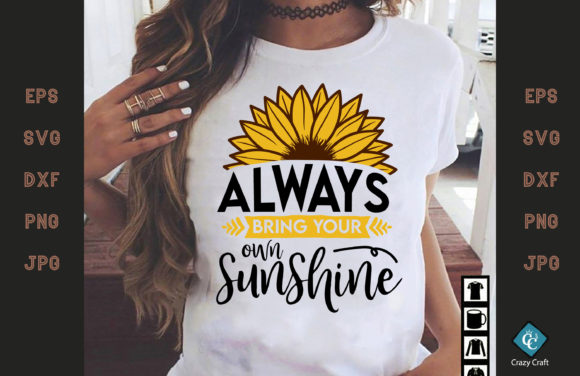
When I opened the Always Bring Your Own Sunshine T-shirt design bundle for my next boutique tote bag launch, I didn’t just see a sunflower and a quote—I saw thread paths, fabric behavior, and customer expectations. This isn’t a decorative flourish; it’s a mood in stitch form. The layout feels balanced but not rigid: the sunflower leans slightly left, the quote curves gently beneath it like a whisper rather than a shout. It’s friendly, grounded, and quietly confident—not cutesy, not clinical. That matters when you’re stitching on organic cotton twill for a handmade kitchen towel line or embroidering a baby onesie where softness and clarity are non-negotiable.
Where It Shines (and Where It Needs Extra Care)
I tested Always Bring Your Own Sunshine T-shirt across three real projects: a linen apron for a local bakery, a lightweight cotton sweatshirt for teen summer camp staff, and a 4-inch embroidered patch for a craft fair vendor bag. On the apron? Perfect. The sunflower’s petals held crisp satin stitch definition, and the script lettering stayed legible at 3.5 inches wide—even with medium-weight cutaway stabilizer. On the sweatshirt? Slightly softer edges on the inner petal details, but still readable. On the patch? Tight corners needed a quick digitizing tweak to avoid thread nesting—but that’s standard for any floral script combo, not a flaw in the original file.
This design naturally fits custom apparel, embroidered patch sets, and personalized gift lines—especially for spring markets, teacher appreciation, or wellness-themed shops. It reads well at 3–4 inches tall, making it ideal for tote bag design, sweatshirt embroidery, and pillow cover accents. But it’s not universally forgiving: avoid using it below 2.75 inches on stretchy knits without adjusting underlay, and skip dense fill-stitch versions on ultra-thin rayon blends unless you’ve pre-tested stabilizer pairing.
Real Fabric Realities: Texture, Color, and Longevity
Fabric texture changes everything—and Always Bring Your Own Sunshine T-shirt behaves differently on dark versus light backgrounds. On navy terry cloth towels, the yellow-gold thread pops only if you choose high-contrast thread colors (think lemon yellow over charcoal, not pale butter). On ivory linen, even subtle ecru thread reads warmly. I found the quote’s thin strokes hold best on stable weaves—baby embroidery on interlock cotton worked cleanly, but on jersey-knit onesies, I added a light tear-away + wash-away combo to keep the script from blurring.
For commercial embroidery, remember: this is a digital embroidery file built for clarity, not density. There’s no excessive underlay or overlapping satin columns—so it stitches efficiently on mid-tier machines and holds up through repeated washing. That’s vital for small shop product longevity. Customers notice when lettering stays sharp after five hot cycles. They also notice when a sunflower looks hand-drawn instead of machine-perfect—and this design walks that line gracefully.
What It Adds to Your Craft Business (Beyond the Stitch)
As an Etsy seller who lists both finished goods and design assets, I pay attention to how a design affects perceived value. Always Bring Your Own Sunshine T-shirt elevates a basic tote from “nice” to “thoughtful”—especially paired with natural fiber tags and minimalist packaging. It signals care, not just craft. For holiday embroidery or wedding gifts, it adds sincerity without sentimentality. And because the composition avoids tight clusters or micro-details, it scales well into printable mockups—no pixelation in your listings, no guessing whether buyers will “get” the vibe.
It also supports brand consistency. If your shop centers around calm positivity—think herbal apothecaries, mindful parenting brands, or slow-living stationery—you can use this as a signature motif across embroidery, sublimation, and even simple iron-on transfers (thanks to the included SVG and PNG files). Just keep thread palettes cohesive: mustard, sage, and oatmeal work together across products far better than neon yellow and black.
Practical Embroidery Designer Notes You’ll Actually Use
- Test first—always—on scrap fabric matching your final garment’s weight and stretch. A 3-inch hoop works for most applications, but confirm before hooping 20 units.
- Check thread color contrast early. Light gold on cream reads beautifully; the same thread on beige chambray fades visually.
- Review stitch density in your editing software. If filling the sunflower center feels too heavy for baby items, reduce density by 10–15%.
- Inspect small details manually: the curve of the “g” in “Bring” and the taper on each petal tip should be clean—not jagged or overly simplified.
- Use proper stabilizer: medium cutaway for knits, lightweight tear-away for stable wovens, and fusible + wash-away for sheer layers.
- Confirm licensing before selling finished items or reselling the digital embroidery file. The bundle includes SVG, EPS, DXF, JPG, and PNG—ideal for hybrid workflows—but commercial rights depend on the source.
Final Thought: A Design That Feels Like a Choice, Not a Trend
Always Bring Your Own Sunshine T-shirt doesn’t shout. It settles in—like a favorite phrase stitched onto a well-worn apron or a sunflower blooming quietly in a kitchen window. It works because it’s designed for real hands, real fabrics, and real customers who choose handmade not for novelty, but for meaning. Whether you’re building a craft business, launching a small shop product, or simply choosing a personalized gift that lands right—it’s the kind of machine embroidery design that earns repeat orders, not just one-time clicks. Just remember: great embroidery starts before the needle moves. Test it. Touch the fabric. Hold the thread up to light. Then stitch with confidence.